
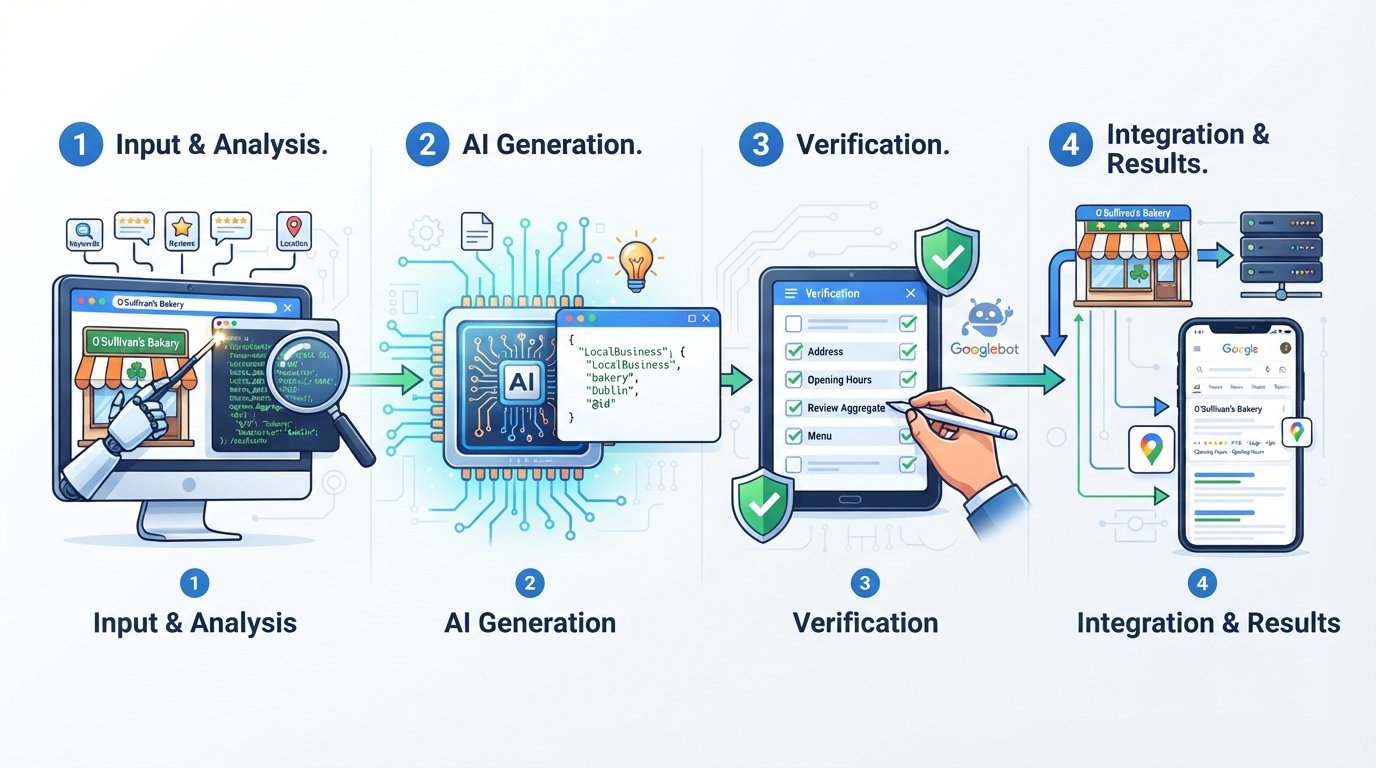
AI-Generated Schema Markup: Boost Your Irish Business on Google
Introduction: How AI-Generated Schema Markup Elevates Your Irish Business on Google
In today's competitive digital landscape, merely having a website for your Irish business isn't enough to stand out. To capture the attention of potential customers searching on Google, your website needs to communicate its value clearly and concisely to search engines. This is where schema markup comes into play – a powerful form of structured data that tells Google exactly what your content means, not just what it says.
Imagine your business appearing in Google search results with star ratings, product prices, event dates, or even direct answers to common questions. This enhanced visibility, often called "rich results" or "rich snippets," makes your listing far more appealing and clickable than standard blue links. For Irish businesses, leveraging schema markup can be the difference between blending in and truly dominating local search results across Ireland's towns and counties.
Historically, implementing schema markup could be a complex, technical task, often requiring developers or an SEO agency. However, the advent of AI has revolutionised this process. With AI-generated schema markup, Irish businesses can now automate this crucial aspect of on-page optimisation, ensuring their website data is perfectly structured for Google without needing deep technical expertise. This guide will walk you through how AI-led website growth tools can simplify and supercharge your schema strategy, helping your Irish business attract more customers from Google by making your presence unmissable.
Who This Is For
- Irish business owners looking to increase their visibility on Google.
- Marketers in Ireland seeking to enhance their website's rich results.
- Anyone interested in leveraging AI to automate complex SEO tasks.
- Businesses without a dedicated SEO team or deep technical knowledge.
- SMEs in Ireland wanting to compete effectively against larger entities online.
Step 1: Understanding Schema Markup for Irish Businesses
Before diving into AI-powered solutions, it's vital to grasp what schema markup is and why it's so important for your Irish business. Schema markup is a vocabulary (a set of tags or microdata) that you can add to your HTML to improve the way search engines represent your page in SERPs (Search Engine Results Pages). It's essentially a shared language that search engines like Google, Bing, Yahoo!, and Yandex use to understand the context of your content.
For an Irish business, this means clearly communicating your services, products, location, customer reviews, and more directly to Google. Instead of Google having to infer what your page is about, schema provides explicit clues. This direct communication is invaluable for local search queries and for standing out in Ireland's competitive market. By implementing schema, you're not just providing content; you're providing structured, understandable data.
- Define Schema Markup: Understand it as a common language for search engines to comprehend your website's content more deeply.
- Identify Key Schema Types:
LocalBusiness: Crucial for any Irish business with a physical location, providing details like address, phone, opening hours (general concept), and type of business.Organization: For overall brand information, including your business's name, logo, and contact details.Product: Essential for e-commerce sites in Ireland, showcasing price, availability, and review ratings directly in search results.Service: Perfect for service-based Irish businesses (e.g., plumbers, solicitors, consultants), describing the services you offer.Event: If your Irish business hosts workshops, webinars, or local gatherings, this highlights event details.FAQPage: Transforms your frequently asked questions into collapsible answers directly in the SERPs, saving users a click.Review/AggregateRating: Displays star ratings, building trust and encouraging clicks.
- Recognise Rich Results: Understand that schema markup enables these visually appealing search enhancements, which significantly improve click-through rates.
Tip: Start with the LocalBusiness and Organization schema types, as these are fundamental for nearly every Irish business. Then, expand to other types like Product, Service, or FAQPage based on your specific offerings.
Step 2: Identifying Key Information for Your Irish Business
The effectiveness of your schema markup hinges on the quality and completeness of the data you provide. Before you even think about generating schema, you need to consolidate all the essential information about your Irish business. Think of this as preparing the ingredients before you bake the cake – the better your ingredients, the better the final result. Accurate and consistent data is not just good for schema; it's fundamental for all your online presence, especially for local SEO.
Google relies heavily on consistent Name, Address, and Phone number (NAP) details across the web to verify your business's legitimacy and location. Any discrepancies can confuse search engines and hinder your visibility. Beyond NAP, details about your services, products, customer reviews, and operational hours are crucial for helping Google present a comprehensive snapshot of your business to potential customers across Ireland.
- Gather Core Business Information:
- Name: Your exact business name (e.g., "O'Connell's Bakery").
- Address: Your full, accurate physical address in Ireland (e.g., "123 Main Street, Dublin 2"). Remember the Google Business Profile updates for Ireland.
- Phone Number: Your primary contact number, including the country code (e.g., "+353 1 123 4567").
- Website URL: Your official website address (e.g., "https://www.oconnellsbakery.ie").
- Email Address: A general contact email.
- Detail Your Offerings:
- Services: List all services you provide, with brief descriptions for each. For instance, if you're a plumber, list "Emergency Plumbing," "Boiler Repair," "Drain Cleaning."
- Products: For e-commerce, gather product names, descriptions, prices, SKUs, and availability.
- Categories: What industry or categories does your business fall into (e.g., "Bakery," "Restaurant," "Hardware Store")?
- Operational Details:
- Opening Hours: General weekly opening and closing times (e.g., "Mon-Fri 9 AM - 6 PM, Sat 10 AM - 4 PM"). Do not invent specific opening hours or branches that are not given in the business context.
- Areas Served: Which towns, cities, or counties in Ireland do you serve?
- Reputational Information:
- Customer Reviews: Links to existing review platforms (Google My Business, Yelp, etc.).
- Aggregate Ratings: If you have an average star rating.
Warning: Ensure absolute consistency of your Name, Address, and Phone number (NAP) across your website, Google Business Profile, social media, and all other online directories. Inconsistent NAP information is a common mistake that can significantly harm your local SEO efforts and confuse search engines.
Step 3: Choosing the Right AI-Powered Schema Generator
Manually writing JSON-LD schema code can be daunting, even for seasoned developers. This is where the power of AI truly shines, especially for Irish businesses looking for an autonomous seo for websites in ireland solution. AI-powered schema generators streamline the process, allowing you to create complex structured data quickly and accurately without needing to understand the intricacies of the code itself. These tools act as an automatic on-page optimization tool, simplifying a traditionally technical task.
When selecting an AI tool, consider ease of use, the range of schema types it supports, and its ability to integrate with your existing website platform. Some tools offer basic template generation, while more advanced ai website optimisation for irish companies platforms can analyse your content and suggest the most appropriate schema types automatically. This is a game-changer for businesses that want to focus on their core operations rather than getting bogged down in SEO technicalities. Look for platforms that understand the nuances of local Irish search needs.
- Evaluate AI Tool Capabilities:
- Ease of Use: Can you input your business details and generate schema without writing code?
- Schema Type Coverage: Does it support the specific schema types relevant to your Irish business (LocalBusiness, Product, Service, FAQPage, etc.)?
- Content Analysis: Does the AI tool analyse your existing page content to suggest relevant schema?
- Updates and Maintenance: Will the tool help you keep your schema updated as your business evolves or as Google's guidelines change?
- Integration: How easily can the generated schema be added to your website (e.g., direct copy-paste, plugin, GTM integration)?
- Consider Dedicated AI SEO Platforms: Platforms like AiDoesSEO are specifically designed to handle various aspects of SEO, including automated schema markup with AI for Irish e-commerce. These comprehensive tools often offer more than just schema generation; they provide an ai-led website growth tool that encompasses content creation, technical fixes, and performance tracking.
- Input Your Data: Use the consolidated information from Step 2 to accurately populate the fields within your chosen AI schema generator. Ensure all details are correct and complete.
Tip: For a truly hands-off approach to seo, consider a platform that integrates AI-generated schema markup as part of a broader how ai can automate website seo strategy. This ensures consistency and leverages AI not just for schema, but for content, technical fixes, and more.
Step 4: Implementing AI-Generated Schema Markup on Your Irish Website
Once your AI tool has generated the schema markup (typically in JSON-LD format), the next crucial step is to add it to your website. JSON-LD (JavaScript Object Notation for Linked Data) is the recommended format by Google for structured data because it's easy to embed and doesn't require complex HTML modifications. The goal is to place this code where Google can easily find and understand it.
The method of implementation will depend on your website's platform (e.g., WordPress, Shopify, custom HTML) and your comfort level with code. For many Irish businesses, especially those using popular CMS platforms, a plugin or a dedicated header/footer script manager will be the easiest route. Regardless of the method, ensure the schema code is placed correctly within the `
` or `` section of the relevant web page.- JSON-LD Format: The generated schema will usually be in JSON-LD format, which looks like a block of JavaScript code. This code needs to be placed within `` tags.
- Placement Options:
- Directly in HTML: For static HTML sites, you can paste the JSON-LD script directly into the `` section of each relevant page. This is the most straightforward for individual pages but can be cumbersome for large sites.
- Using a CMS Plugin (e.g., WordPress): Many SEO plugins for WordPress (like Yoast SEO or Rank Math) have dedicated sections for adding custom schema or automatically generate basic schema based on your page content. Alternatively, header/footer script injection plugins allow you to paste JSON-LD snippets.
- Through Google Tag Manager (GTM): This is a powerful and flexible method. You can create a custom HTML tag in GTM, paste your JSON-LD schema into it, and configure it to fire on specific pages (e.g., your homepage, product pages, service pages). This is ideal for managing schema across a larger site without touching the website's code directly.
- CMS-Specific Features: Platforms like Shopify or Squarespace might have built-in fields for structured data, or you might use apps/extensions from their marketplaces to manage schema.
- Target Specific Pages: Ensure the schema markup is applied to the correct pages. For example,
LocalBusinessschema goes on your homepage and contact page.Productschema goes on individual product pages.Serviceschema goes on service pages.
Warning: Always back up your website before making any code changes, especially if you're directly editing theme files. Incorrectly placed or malformed code can break your website or cause unexpected issues. If unsure, consult with a web developer or use a reliable plugin/GTM.
Step 5: Testing Your Schema Markup with Google's Tools
Implementing schema markup is only half the battle; verifying its correctness is equally important. Google provides free, robust tools to help you test and validate your structured data. Skipping this step is a common mistake that can lead to missed opportunities for rich results. Even if your AI tool generates technically sound schema, conflicts with existing website code or incorrect placement can still cause issues.
Testing ensures that Google can correctly parse and understand your markup, making your Irish business eligible for those coveted rich snippets. It also helps you identify any errors or warnings that need to be addressed before Google crawls and indexes your pages. Regular testing, especially after making updates to your site or schema, is a best practice for maintaining optimal on-page optimisation.
- Google's Rich Results Test:
- Go to Google's Rich Results Test.
- Enter the URL of the page where you've implemented the schema, or paste the code snippet directly.
- Click "Test URL" or "Test Code."
- Review the results. This tool will tell you if the page is eligible for rich results and highlight any errors or warnings.
- Pay close attention to "Valid items detected" and look for the specific schema types you've implemented (e.g., LocalBusiness, Product).
- Schema Markup Validator (Deprecated but still useful for raw schema validation):
- While the Rich Results Test is primary for rich result eligibility, the Schema Markup Validator (formerly Google's Structured Data Testing Tool) can still be useful for more granular raw schema validation, showing a full parse tree of all structured data found.
- Use this to see exactly how Google interprets every piece of data you've marked up.
- Address Errors and Warnings: If the tools report any errors, go back to your AI generator or directly edit the schema code (if you're comfortable) to fix them. Warnings usually mean Google can still process the schema, but there might be missing recommended fields that could enhance your rich result.
Tip: Always test after initial implementation and anytime you make significant changes to your website content, structure, or schema markup. This proactive approach ensures your Irish business always presents its best self to Google.
Step 6: Monitoring Performance and Iterating for Irish Search Results
Implementing and testing schema markup isn't a one-and-done task. For your Irish business to truly leverage the power of rich results, continuous monitoring and iteration are essential. Google's algorithms evolve, and so should your strategy. Understanding how your rich results perform in actual search queries provides invaluable insights, allowing you to refine your approach and ensure your ai website optimisation for irish companies is constantly driving results.
Google Search Console (GSC) is your best friend here. It provides dedicated reports that show you which rich results Google has detected on your site, any issues it encountered, and how they are performing in terms of impressions and clicks. This data allows you to identify what's working well and what needs improvement, ensuring your local business website growth software is truly effective.
- Utilise Google Search Console (GSC):
- Enhancements Reports: In GSC, navigate to the "Enhancements" section. Here, you'll find specific reports for various rich result types (e.g., "Products," "FAQs," "Local Business," "Events").
- Monitor Status: Check these reports regularly to see how many valid items Google has detected, how many have errors, and how many have warnings. Address any issues promptly.
- Performance Reports: Use the "Performance" report in GSC to filter by "Search appearance" (e.g., "Review snippet," "FAQ rich result"). This allows you to see the impressions, clicks, and CTR (Click-Through Rate) of your rich results. This is crucial for understanding the impact of your schema on your Irish audience.
- Analyse Performance Data:
- High Impressions, Low Clicks: If a rich result has high impressions but low clicks, it might indicate that the content is visible but not compelling enough, or perhaps the query intent isn't perfectly matched.
- Errors/Warnings: Prioritise fixing any errors immediately, as they prevent rich results from appearing. Warnings are less critical but can still improve your eligibility if addressed.
- Iterate and Refine:
- Based on your GSC data, identify opportunities to add more schema or refine existing ones.
- If a particular service or product for your Irish business isn't getting rich results, investigate why. Is the schema missing or incorrect? Is the content on the page insufficient?
- AI can also assist in this iteration process by monitoring changes in Google's guidelines or identifying new schema opportunities based on emerging content or search trends. This proactive approach is key for ai content optimisation for local business websites.
Tip: Pay particular attention to the "Search Appearance" filter in Google Search Console's Performance report. This directly shows the impact of your schema markup on real user engagement in Ireland, helping you refine your strategy.
Step 7: Advanced AI-Driven Schema Strategies for Local Irish SEO
While basic schema markup significantly improves visibility, leveraging advanced AI-driven strategies can truly elevate your Irish business's presence in Google search results. Autonomous seo for websites in ireland goes beyond simply generating code; it intelligently identifies opportunities to enrich your data, making your website an undeniable authority in your local market. This comprehensive approach is what truly differentiates a modern SEO strategy.
AI can assist in identifying niche schema types that might be highly beneficial for your specific industry in Ireland, such as `ServiceChannel` for customer support, `SpecialOffer` for promotions, or even domain-specific schemas like `Restaurant` or `AutomotiveBusiness`. Furthermore, AI can help ensure the semantic accuracy and depth of your structured data, linking various entities together to form a richer, more interconnected web of information that Google loves. This is especially powerful when combined with ai internal linking automation to create a robust, interlinked site architecture.
- Contextual Schema Generation:
- Semantic Analysis: Advanced AI tools can analyse the natural language content of your pages and suggest schema types and properties that perfectly match the context, rather than just relying on generic templates. For example, if your page talks about "traditional Irish soda bread recipe," the AI might suggest `Recipe` schema.
- Entity Recognition: AI can identify specific entities (people, places, organisations, products) mentioned on your pages and automatically mark them up with appropriate schema, enhancing Google's understanding of your content's subject matter for an Irish audience.
- Combining Multiple Schema Types:
- Instead of just a single
LocalBusinessschema, consider nesting other relevant schemas within it. For example, aLocalBusinessschema could contain `AggregateRating` and `Service` schemas. - For an Irish e-commerce site, combine
Productschema withOfferandReviewschema to present a complete picture. - For local service providers in Ireland, a
Serviceschema can be enhanced withareaServedproperties to explicitly state your geographical coverage.
- Instead of just a single
- Dynamic Schema Updates:
- AI can monitor changes on your website (e.g., new products, updated prices, changed opening hours) and automatically update the corresponding schema markup, ensuring your structured data is always fresh and accurate. This is crucial for maintaining real-time accuracy and keeping your ai-led website growth tool effective.
- For instance, an ai article generation for seo tool that creates new blog posts might also automatically generate `Article` schema for each new piece of content.
- Hyper-Local & Niche Schema for Ireland:
- Leverage `Service` schema for highly specific local services offered by your Irish business (e.g., "Thatched Roof Repair in Kerry," "Traditional Irish Music Lessons in Galway").
- Use
GeoCoordinateswithin yourLocalBusinessschema for precise location targeting, especially beneficial for businesses in small towns or rural areas of Ireland. - Explore industry-specific schemas (e.g.,
Dentist,Restaurant,BeautySalon,RealEstateAgent) to provide highly relevant details for your sector.
- AI and AI Internal Linking Automation: An ai internal linking automation strategy can work hand-in-hand with schema. As AI identifies related entities and concepts through schema, it can also intelligently suggest and implement internal links between relevant pages, further enhancing both user experience and search engine understanding of your site's structure and authority.
Tip: Don't just apply schema universally. Think about each page's unique purpose and how specific schema types can best describe its content to Google, particularly for your target Irish audience. The more granular and accurate your schema, the better your chances of standing out.
Common Mistakes to Avoid with AI-Generated Schema Markup
While AI makes schema generation significantly easier, it's not a set-it-and-forget-it solution without any potential pitfalls. Understanding and avoiding common mistakes can save your Irish business from wasted effort and ensure your seo strategy remains effective.
- Incomplete or Inaccurate Data: The AI tool is only as good as the input you provide. If you feed it incorrect addresses, phone numbers, or product details, it will generate flawed schema. Always double-check your source data.
- Applying Incorrect Schema Types: Using a `Product` schema on a blog post or a `LocalBusiness` schema on a purely informational page will confuse Google and likely won't result in rich snippets. Ensure the schema type genuinely matches the page content.
- Not Testing Your Markup: As highlighted in Step 5, failing to use Google's Rich Results Test is a critical error. Without testing, you won't know if your schema is valid or if it's eligible for rich results.
- Keyword Stuffing in Schema: While schema helps Google understand your content, don't try to "stuff" keywords into schema properties that aren't meant for them. This violates Google's guidelines and can lead to penalties. Keep it natural and relevant.
- Ignoring Google's Guidelines: Google has clear structured data guidelines. Violating these (e.g., marking up hidden content, using schema for misleading purposes) can result in manual actions against your site.
- Over-reliance on Automation Without Review: While AI is powerful, a human review is still valuable, especially for nuanced or complex schema. Periodically review what the AI has generated to ensure it accurately reflects your Irish business.
- Not Monitoring Performance: Implementing schema isn't the end. You need to monitor its performance in Google Search Console to see if it's actually generating rich results and attracting more clicks for your Irish customers.
- Using Outdated Schema: Schema.org and Google's guidelines are constantly updated. Ensure your AI tool or manual process keeps your schema current. Outdated properties might become deprecated and cease to provide benefits.
FAQ
Is AI-generated schema markup effective for local Irish businesses?
Absolutely. AI-generated schema markup is highly effective for local Irish businesses. It helps Google understand precise details like your business type, address, phone number, and opening hours, making your business eligible for local rich results. This significantly boosts your visibility in local search results across Ireland, helping you attract more customers directly from Google Maps and local search queries. For instance, an AI hyper-local SEO strategy often heavily relies on accurate schema.
What's the difference between structured data and schema markup?
Structured data is a general term for any data organised in a defined format, making it easier for machines to understand. Schema markup, specifically Schema.org, is a *type* of structured data vocabulary. It provides a specific, standardised set of tags (properties and types) that webmasters can use to mark up their content. So, all schema markup is structured data, but not all structured data is schema markup.
How often should I update my schema markup?
You should update your schema markup whenever there are significant changes to your business information (e.g., new address, phone number, services, products, or opening hours) or to the content on the page where the schema is applied. Additionally, it's good practice to review your schema periodically (e.g., quarterly) to ensure it aligns with current Google guidelines and to check for any new, beneficial schema types that have emerged. An advanced ai-led website growth tool can often automate these updates.
Can schema markup guarantee a top ranking on Google?
No, schema markup does not guarantee a top ranking. While it significantly increases your chances of appearing in rich results (which are very prominent in SERPs) and can boost your click-through rates, it is not a direct ranking factor in the traditional sense. It helps Google *understand* your content better, which can indirectly contribute to better rankings if your content is relevant and high-quality. It's one piece of a larger seo puzzle, working alongside good content, technical SEO, and backlinks.
How does AiDoesSEO help with schema markup for Irish businesses?
AiDoesSEO offers a comprehensive automatic on-page optimization tool that includes AI-driven schema markup generation. Our platform automatically identifies the most relevant schema types for your content (whether it's a product, service, local business, or FAQ) and generates accurate JSON-LD code. This ensures your Irish business is eligible for rich results on Google, enhancing visibility and attracting more customers, all without you needing any technical SEO knowledge or hiring an expensive agency. It's part of our autonomous seo for websites in ireland promise.
Next Steps: Elevate Your Irish Business with Automated AI SEO
Ready to unlock the full potential of AI-generated schema markup and other advanced SEO strategies for your Irish business? Register with AiDoesSEO today and experience the power of a fully automated, AI-driven platform designed to get you more customers from Google, faster and more affordably than ever before. Let our ai-led website growth tool handle the complexities of SEO, while you focus on what you do best – running your business.